
- Published on 9 May 2024
- Last updated on 2 Aug 2025
- Reading Time: 10 minutes
What's up with Llama 3? High data analysis
On April 18th, Meta released Llama 3, their newest open-weight large language model. Since then, Llama 3-70B has quickly risen to the top of the English Chatbot High leaderboard with over 50,000 battles. This remarkable achievement by Meta is excellent news for the open-source community. In this blog post, we aim to provide more insight into why users rank Llama 3-70b on par with top-ranked models like GPT-4-Turbo, Gemini 1.5 Pro, and Claude 3 Opus.
We investigate the following:
- What types of prompts are users asking? Do users prefer Llama 3 on certain types of prompts?
- How challenging are these prompts? Does the ranking change if the prompts are easier/harder?
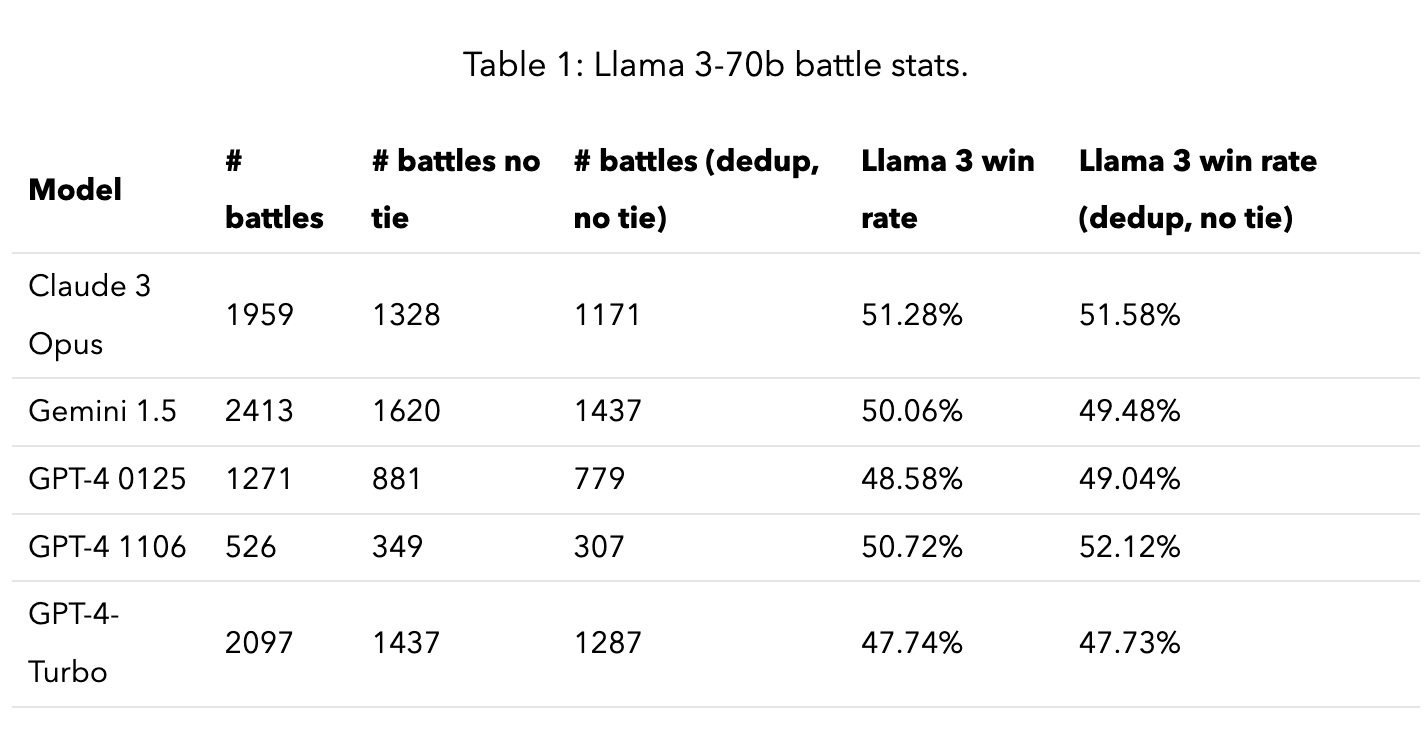
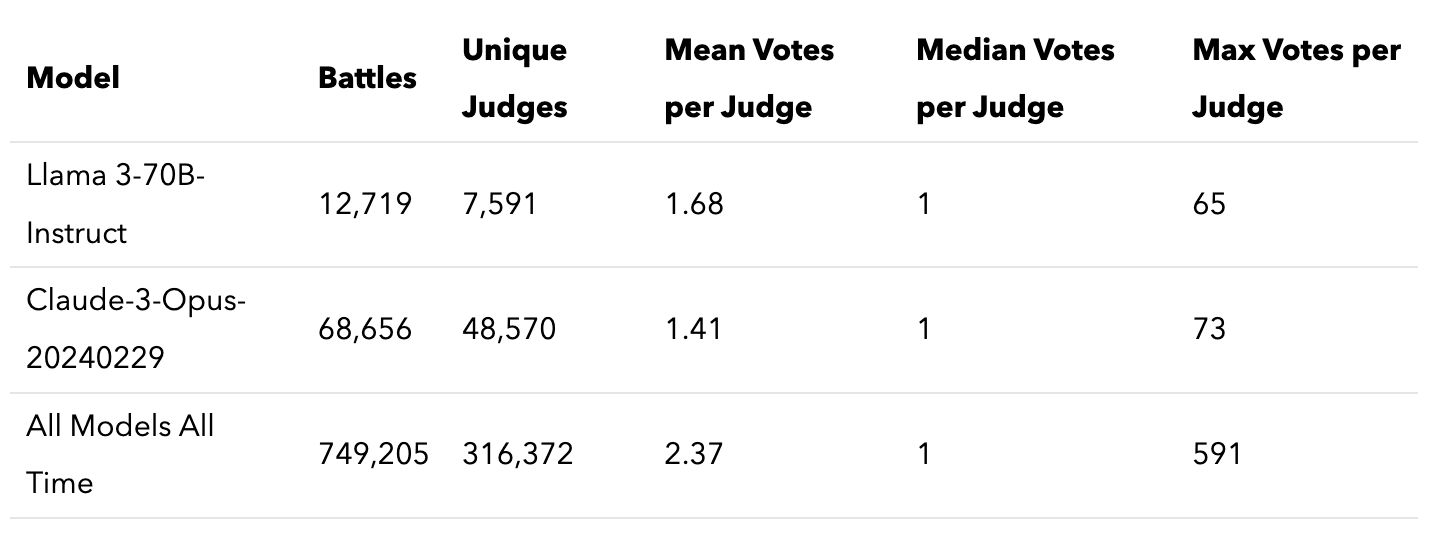
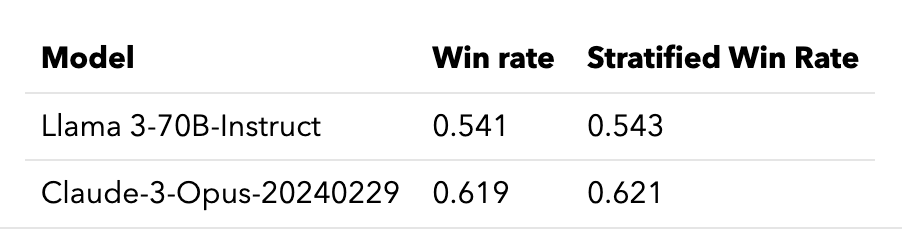
- Are certain users or prompts overrepresented? Do duplicate prompts or rankings from a small number of users affect the win rate?
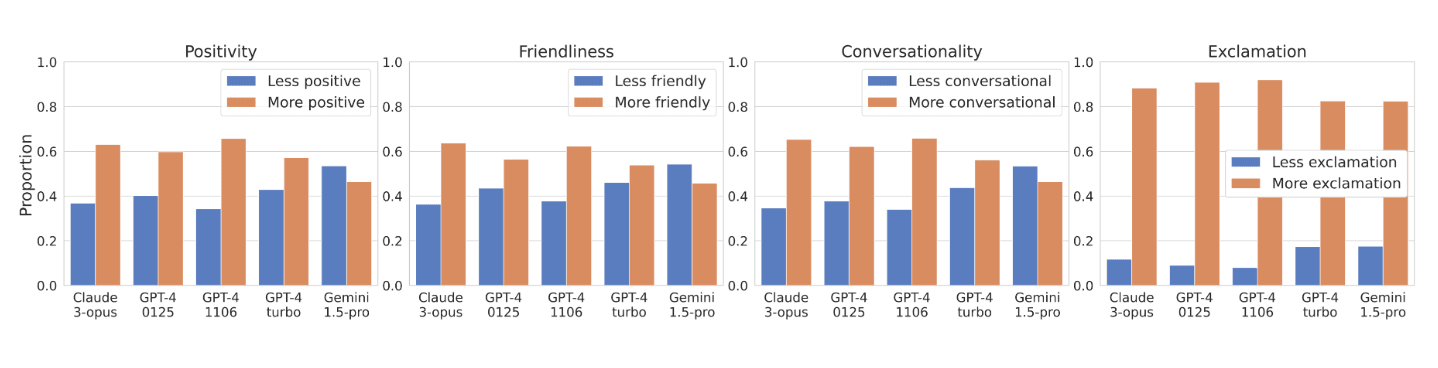
- Does Llama 3 have qualitative differences which make users like it more?
We focus on battles consisting of Llama 3-70b against 5 top-ranked models (claude-3-opus-20240229, gpt-4-0125-preview, gpt-4-1106-preview, gpt-4-turbo-2024-04-09, gemini-1.5-pro-0409-preview) and reach the following conclusions:
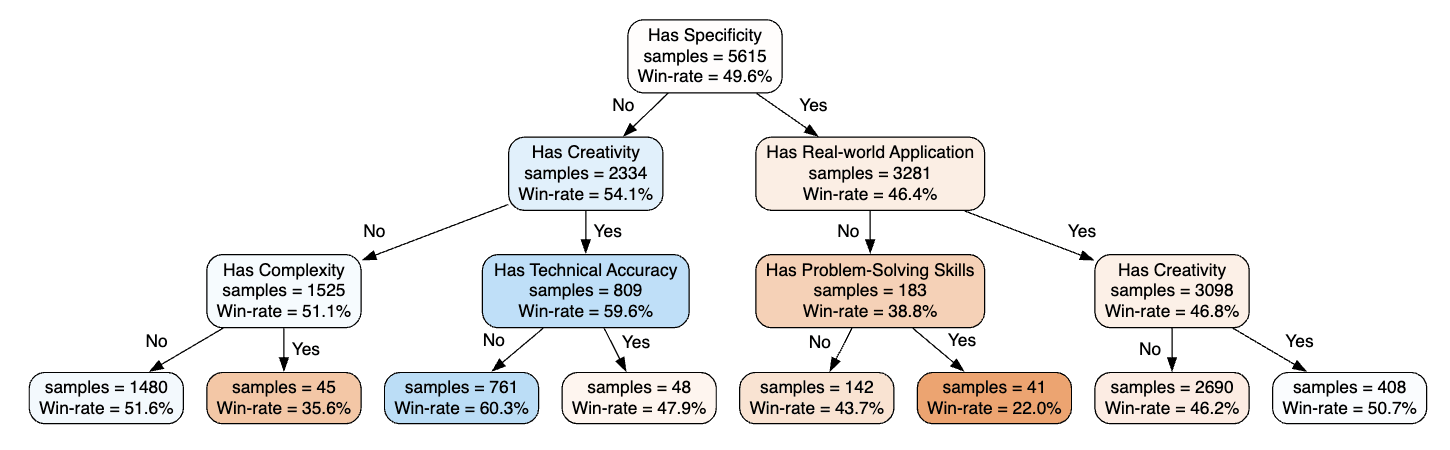
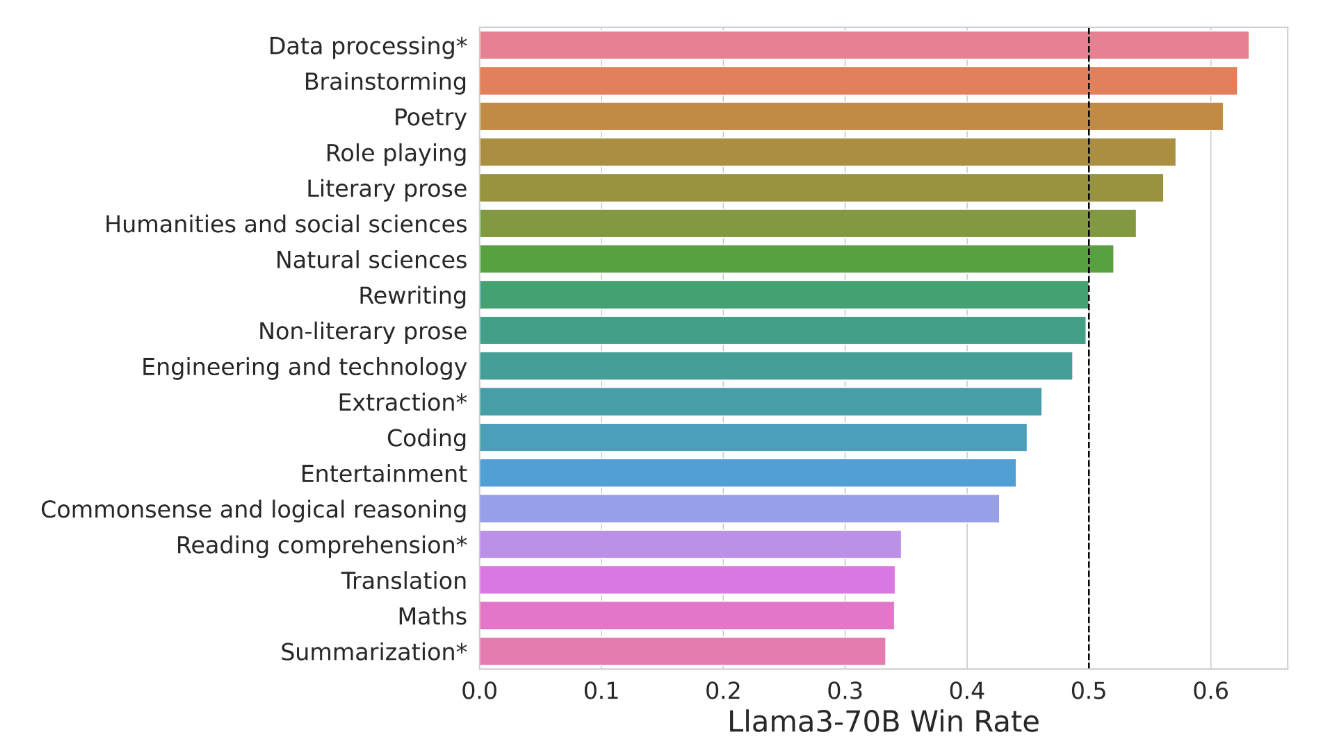
- Llama 3 beats other top-ranking models on open-ended writing and creative problems but loses on more close-ended math and coding problems.
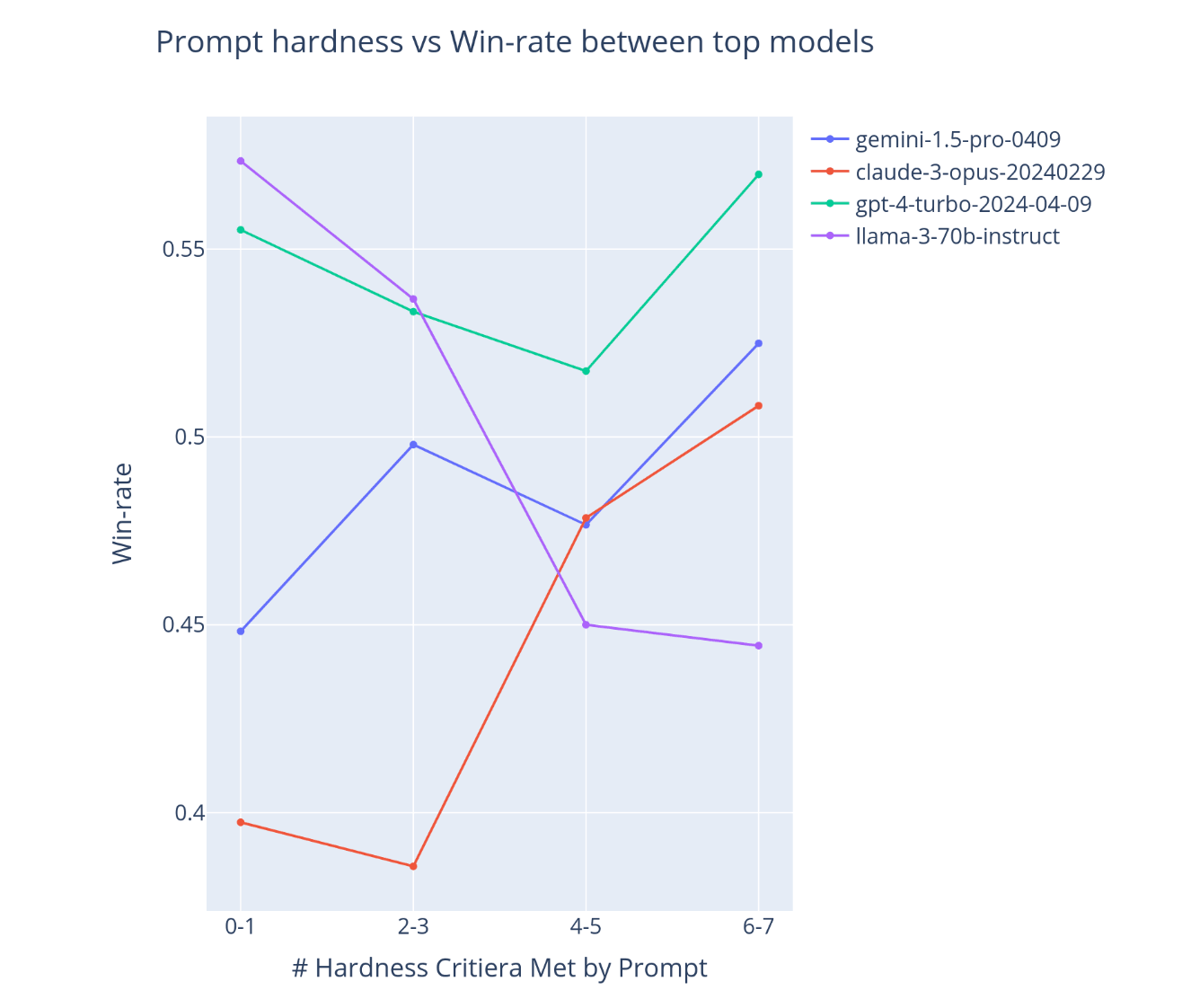
- As prompts get harder, Llama 3’s win rate against top-tier models drops significantly.
- Deduplication or outliers do not significantly affect the win rate.
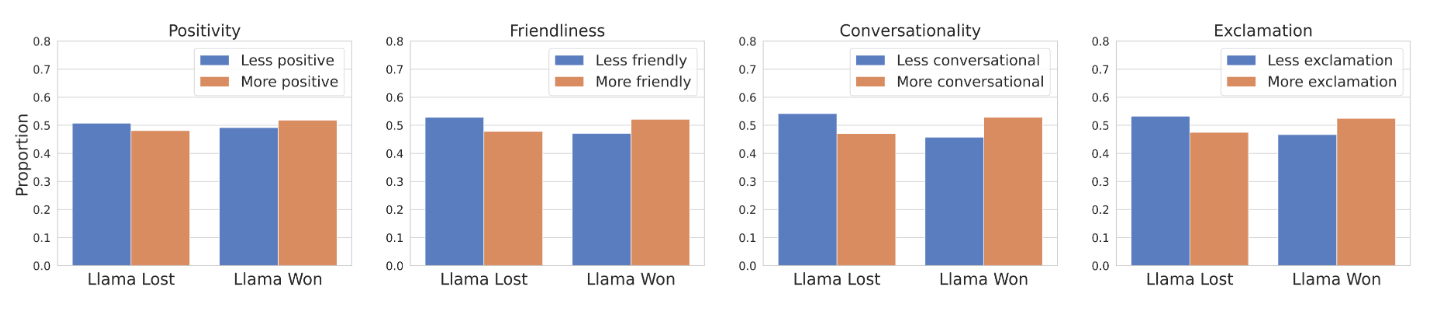
Qualitatively, Llama 3’s outputs are friendlier and more conversational than other models, and these traits appear more often in battles that Llama 3 wins.
Analyzing win rate across different types of prompts
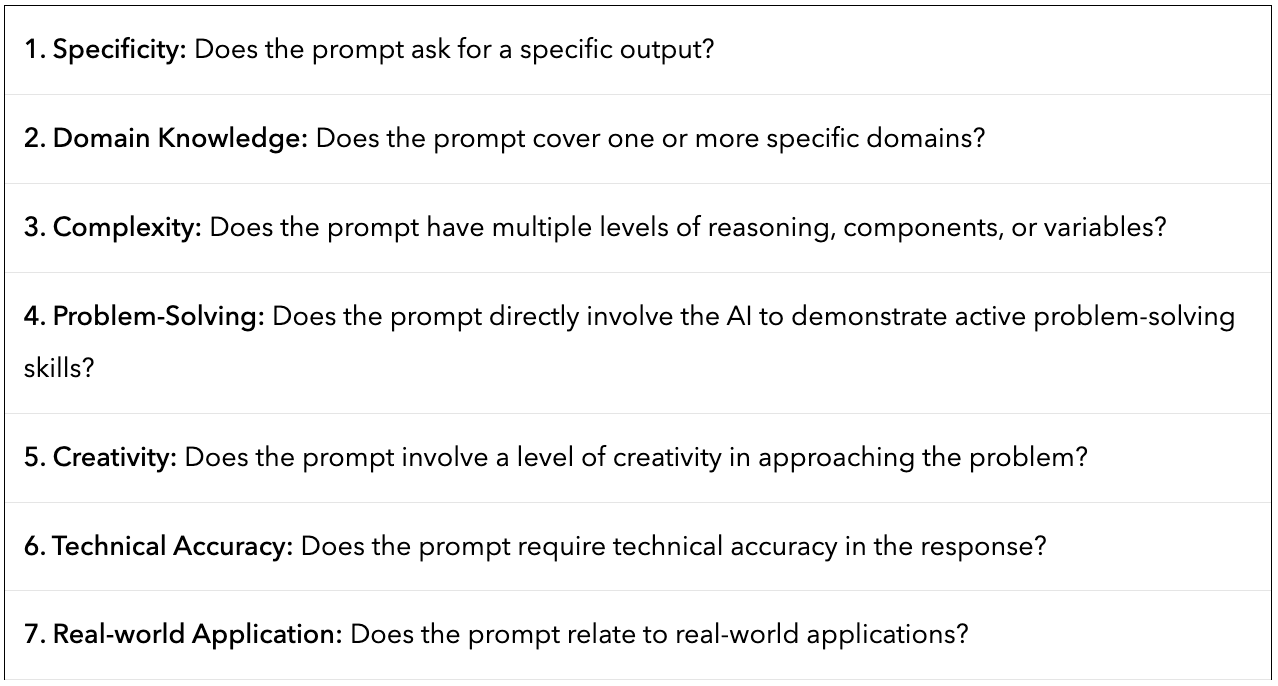
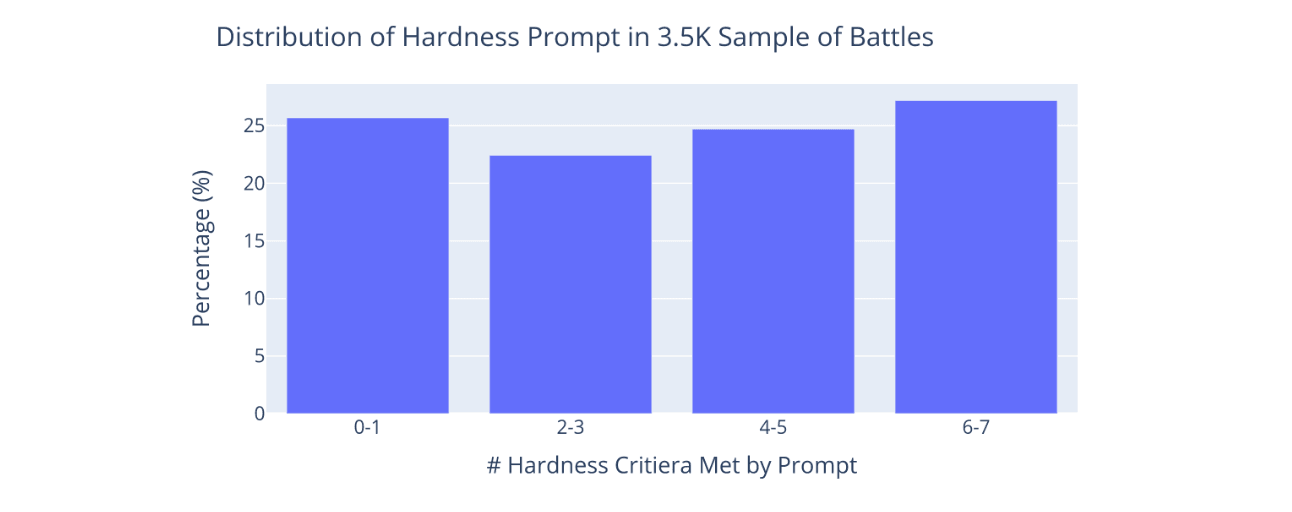
Topic Analysis. We utilize an LLM labeler (Llama 3-70b) to categorize user prompts into a pre-established taxonomy of topics () and visualize the win rate of Llama 3-70b against the other top models in Figure 1. We see that Llama 3’s win rate is highest for open-ended and creative tasks like brainstorming and writing, and lowest for more close-ended technical tasks like math and translation. Interestingly, Llama 3 achieves the highest win rate over data processing tasks which mainly consist of parsing and dataframe operations, but as this category has only 19 examples, this remains inconclusive. We employ our which scores the difficulty of prompts to determine how Llama 3 compares to the other top models as prompts get harder. We define a set of “hardness” criteria and use GPT-4-turbo to annotate each prompt from 0 to 7 to indicate how many of these criteria are satisfied (a higher score indicates a harder prompt). Our 7 criteria are: